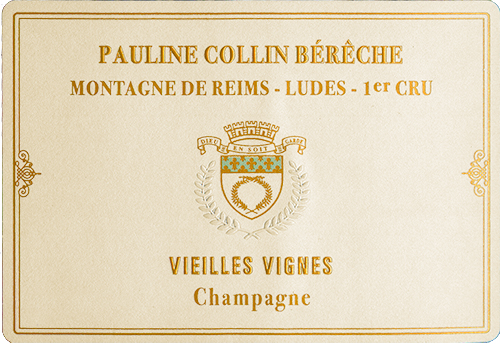
Pauline Collin Bérêche
Ludes
Pauline Collin Bérêche
2 hectares
Organic

A Vigernonne’s Unconventional Path
One wine, one terroir, one vintage.
In Champagne you needn’t look far to find wine families that go back three or four generations. Even seventh-generation legacies are not unheard of, and of course, patrimony runs deep. You’d have to look hard to find a winemaker who takes equal inspiration from their grandmother, which brings us to the singular, deeply layered wine of Pauline Collin Bérêche.
Pauline’s great-grandfather, Roland Collin, founded the Ludes cooperative in 1945. His son Louis followed and guided the co-op for more than 20 years until his son, Didier, took his turn. Under Didier’s care, innovation became the watchword. He implemented integrated viticulture long before it became widely embraced as essential, incorporating climate data and vine health modeling into a tradition of painstaking observation.
Didier married Dominique Guillaume, a family name that today carries weight far beyond Champagne (the Guillaumes are now legendary pépiniéristes, a dynasty of vine nurserymen who’ve helped shape vineyards across the globe). As Didier and Dominique brought Pauline and two more daughters into the world, they doubled down on their commitment to the land. They reduced chemical inputs in the vines and began feeding the soils with bark mulch and cover crops. Biodiversity was allowed to flourish.
Yet for all the vision and discipline Pauline’s grandfather and father brought to the enterprise, when Pauline looked out into the vineyards, the figure who stood out most to her was her grandmother. The men of the family may have been out in front, leading the co-op and the winegrowers’ syndicate, but vineyard care fell substantially onto the shoulders of her grandmother. Pauline could never shake the feeling that her drive and responsibility was never met with the appreciation it deserved. “She was always in the shadow, yet doing all the hard work.”
By this point, the Guillaume-Collin estate, which grew most of its grapes for the Ludes co-op, spanned 8.5 hectares planted to Pinot Noir, Meunier, and Chardonnay, along with rare whites like Arbanne and Petit Meslier—varietals the family was careful to preserve.
Pauline, like her sisters, set out to chart her own path. She attended business school, spent time abroad, and got some hands-on experience at esteemed Champagne houses Ruinart and Krug. Yet the pull of home was strong. She returned and married an ambitious and brilliant Raphaël Bérêche. The rapid rise of Raphaël and brother Vincent Bérêche’s estate followed—a period during which Pauline formed her own role at their domaine, all while raising two children.
Yet the working mother was decidedly not one to remain in the background. Even with two little ones at home, she made a decisive shift.
Pauline formalized her training with a three-year technical program in Avize while drawing deeply on her father’s experience and the wisdom of the longtime domaine team. Her namesake Champagne was born in the 2016 vintage, drawn entirely from a small plot of old-vine Pinot Noir on the Guillaume-Collin estate. The wine fermented in barrel and aged 48 months on the lees. She finished it with a whisper of dosage. Her mantra was clear from the beginning: one wine, one terroir, one vintage. No more. No less.
Her resolve was tested early when her father fell seriously ill over the summer of 2018. With a six-month-old at home and harvest looming, Pauline stepped up in the vines. It was a trial by fire, but she more than managed, earning her father’s quiet blessing: “My father gave me the reins early,” Didier told her. “Now I’m doing the same for you.” Though officially retired, he remained close, offering guidance with restraint.
In 2019, a vintage that now feels like a breakthrough, the cuvée was expanded with Chardonnay and a touch of Petit Meslier—a nearly extinct, early-budding variety that contributes verticality thanks to its ability to retain high acidity even in the warmest years. “A little goes a long way,” she says. But its lift is essential, offering exotic brightness without compromising purity. The 2019 vintage was left without dosage—its natural 3.5 grams of residual sugar offering just enough balance.
Today, Pauline’s barrels rest in the Bérêche cellar. She leans on her family and the strong wine-growing community, and they lean on her. She listens, she shares, and she reflects on the women who paved the way—her grandmother remaining a guiding presence.
Now, she wears the title vigneronne with tranquil self-assurance. It’s no longer something to dream about or grow into, but a role she fully inhabits. Challenging seasons, inevitable mistakes, and long days in the vines have all contributed to a confidence that is palpable in each bottle. The secret seems to lie in having chosen the perfect level of focus—forgoing the need to expand the range in favor of maintaining a laser-like concentration on a single wine per vintage from land she knows so intimately. Her wines soar precisely because her ambitions are grounded: more time in the vineyard, more time with her children, and better practices for Champagne’s future.
wines
Varietal/Blend
Pinot Noir (60%), Chardonnay (35%) and Petit Meslier (5%)
Vineyard Area
Drawn from 2 hectares in Ludes, consisting of exclusively older vines tended organically.
Soil
Very fine-grained clay- and chalky limestone
Elevation
220 meters
Vinification
Slow barrel-fermentation with extended aging on the lees.
Maturation
48 months sur latte (one single vintage and a single disgorgement per release)
Marketing Materials:
Labels + -